Saturday, July 18, 2015

Saint Petersburg, Russia

Photos - Day 1, Day 2
  • Sat/Sunday, July 18-19, 2015: 7 am Sat - 6 PM Sun

    - Because we signed up for our cruise at the last minute, English speaking shore excursion was sold out.  (Most passengers on our ship were Germans and Italians.)  We were very disappointed - it was too late to get a Russian visa on our own AND it was expensive.  These days, most countries have outsourced visa issuance to private companies such as http://www.visaexpress.net/russia/russiatouristvisa.htm who charge a lot of money to get it done - even more for Rush or Urgent orders, as you can see below.  Even at the cheapest option, we would shell out $193+$79+$27 = $289 just to enter the country.  All sightseeing will be additional.

    - Consulate Fee & Service Fee:
SERVICE TYPEENTRIESCONSULATE FEESERVICE FEEPROCESSING TIME
REGULAR1$193$798 BUSINESS DAYS
REGULAR2$193$798 BUSINESS DAYS
RUSH1$283$1593 BUSINESS DAYS
RUSH2$283$1593 BUSINESS DAYS
URGENT1$313$19924 HOURS
URGENT2$313$19924 HOURS
Return Shipping Option & Fee: Extra $27-$75.

  • I couldn't imagine cruise ship passengers being stranded on the ship only because they don't have a visa OR excursions were sold out.  There had to be a way.  That's when I found TJ Travels.  TripAdvisor reviews were great.  Their itinerary was better than the one offered by the cruise line, and less expensive.  We didn't have to pay in advance, and we didn't need a visa.  For $285 - about the same amount of money as getting a visa (coincidence?), we were able to do a two-day shore excursion - All Highlights St Petersburg Excursion - a 20 hour full itinerary.  We had to stay with the tour group the entire time, but then there was no reason not to.
    Price included admission fees to all museums, photo and video permissions at the museums (except for Yusupov Palace, where camera pass is 5$ pp, video pass is 12 pp), hydrofoil ride and a boat trip along rivers and canals, guide and driver, Mercedes minibus with A/C, all port fees, blanket visa, all local taxes, two traditional Russian lunches, bottled water each day, headsets for the group.
    - I signed up online on July 11 - three days before the cruise started and only a week before we arrived in St Petersburg.  Unlike other companies, TJ responded to my emails quickly, and provided very clear instructions about how and where to meet their guide.  They assured us that cruise ship can not stop us from getting off the ship, and Russian immigration doesn't care who the tour company is as long as we have a reservation - apparently the most asked question.  I still had my doubts, and only after getting the visa at the port that I believed that we will see St Petersburg on this trip after all.  
  • A smaller bus/group works much better than the big buses cruise ship provided.  With only 11 people - 4 families including 3 preteens (all Americans), it was easy to keep the group together and on time.  Free wifi on board, a safe place to leave valuables if necessary, bottled water and umbrellas/ponchos (that we did NOT need) - everything was thought of and taken care of.  With individual headsets, we were able to hear everything that our guide Daria was saying - even in crowded Hermitage.  Russian lunches on both days were a nice touch - though ice cream for dessert didn't sound much Russian.
  • Daria was very knowledgeable, friendly, and spoke very good English.  Most importantly for us, the weather cooperated - in fact, it was surprisingly clear on both days except light drizzle on second morning.  St Petersburg doesn't have two such days in a row that often.  A couple of days later, we heard a report that there was hailstorm there.
  • Payment with a credit card was taken on the second day in the afternoon - one of the last things we did.  We received a souvenir bag, and shots of vodka to boot.  We had only one shopping stop - that too because one family asked for it.  No pressure tactics or wasting time at local shops.  Very positive experience.
The itinerary, subject to change, was as follows:


  • Actual itinerary was slightly different, but all items were covered, with no rush.
  • Like clockwork, the ship docked on time, so we could depart at 7 am.  I was expecting a mad rush of people wanting to get out and then having to endure long lines at Immigration.  We had arrived at the ship exit a bit earlier, so we were in fact the first ones to get off the ship, and therefore, at the Immigration.  After checking the passport and our tour reservation, passport was stamped and we were give a loose slip of paper noting a two day blanket visa - we had to safe keep that and return to Immigration when leaving.  
  • Just outside, Daria (guide), Tatyana (owner) and Alex (driver) greeted us and led us to the waiting minibus.  Two other families from our ship joined soon thereafter.  To pick up the fourth family, we drove to the adjacent pier where Norwegian was docked.  They were delayed getting out so we had to wait a while.  St Petersburg is known for its horrendous traffic jams.  For us, it being a weekend, traffic wasn't bad at all, and we were still ahead of schedule.  
  • The city straddles the Neva river and is connected by many bridges - some of them are opened at night for ship traffic.  A drive along the Neva river gives you the lay of the land (pretty much all the sites we visited in two days) and some nice pictures.  We also had a stop near St Isaac's Cathedral for outside pictures.  
  • We were still early for the 10 am Hydrofoil ride to Peterhof, so we visited a metro station “
    Admiralteyskaya.”  Why would anyone visit St Peterburg to see a metro station - I had wondered.  How does a metro station become a tourist attraction - but it was.
    - Only recently opened, this is the deepest metro station in Russia - with escalators almost 400 feet long.  During cold war, it was designed as a bomb shelter, and is now decorated with mosaics all over.  Until recently, even picture taking was not allowed inside the station. Worth visiting even if you do not need to take the metro. 
    - Because we needed to deposit tokens to enter the station, Daria offered to ride the train to the next station, turn around and come right back.  None of us were interested.
    - The  station is located only one minute walk from Nevsky Avenue and five minutes walk from Dvortsovaya Square - ideal for tourists to visit the central part of the city.  Entry and exit are located at the intersection of Malaya Morskaya Street and Kirpichniy Lane - very close to Palace Square.  
  • Hydrofoil dock is adjacent to Hermitage - on the other side of the Palace Square.  TJ Travels had the tickets ready for us.  We left right on time.  Hydrofoil to Peterhof takes roughly 45 minutes. It is the fastest and most expensive way (about 700 Rubles) to get there. Hydrofoil ride did not feel any different/special other than being fast and very noisy.
  • As soon as we docked, the pier led to ticket windows for Peterhof.  By the time we reached there, Daria had those tickets ready and we rushed towards the palace. A lot of groups were already there.   Show began exactly at 11 am when all fountains started one by one - all operating under gravity, no pumps.
  • Peterhof or Petergof ("Peter's Court") is famous for its palaces and gardens - laid out on the orders of Peter the Great and sometimes called the "Russian Versailles." The area was extensively damaged during World War II during occupation by Nazi Germany. Reconstruction efforts began almost immediately after the war, and are still continuing. Nevertheless, what you see is breathtaking.  
  • From the lower gardens, you can enter upper gardens for free, but not the other way around.
  • The gardens are well manicured and fountains are all around - small and large, some are gimmicky and will get you wet when you are not watching. A small canal from the gulf all the way to the steps of the palace is symbolic of Peter the Great's victory over Sweden, bringing him back to his palace by boat. Fountains on both sides of the canal as well as the gilded statues and fountains at the steps of the Palace are a sight not to miss (picture tells the story.)
  • We did not visit the palace itself - short on time and long lines. Catherine Palace and Hermitage more than made up for it.
  • By then, it was lunch time already.  We drove to a nearby lunch place that looked like a two story bungalow converted to a restaurant.  Another bus load from TJ Travels also joined us for lunch, which was pre-ordered.  Courses were brought in one after the other, and we were done before we knew it.  
  • There are usually at least three courses to a Russian lunch. First course, a heavy Russian “salad”; usually made of potatoes, hard-boiled eggs, carrots, pickles, chicken or ham, and mayonnaise.  Second course is usually soup, such as Borsch, served with sour cream.  This one had beets in them, which some don't like.  Third course is usually a meat dish consisting of a piece of meat with buckwheat porridge or mashed potatoes.  Tea or coffee are typically served with lunch.  For dessert, Ice Cream.
  • After lunch, we traveled to Tsars’ Village in Pushkin, about an hour away, feeling relaxed after lunch.  We still had three more places to see.  First up was Catherine's Palace.  Named after Catherine the Great, this  Palace and the surrounding gardens make you feel like a royalty. Huge gilded rooms, fine furniture, imported silk wallpaper and imported china serving pieces are everywhere.  And of course, the Amber Room.  This room, aptly decorated in Amber, was destroyed and no photos or drawings were found.  What you see now is partly original amber art, with rest filled in with replacement parts to match what the original might have looked like.  Shoe covers are needed to protect the Parquet floors. Outside grounds and gardens were very well maintained.
  • Like all other places, you always want more time there if possible. Instead use the time you have to hit the highlights. A guided tour, which we had, help move you through and cover the main areas.  No photos of Amber Room.
  • A 4.30-5:00 pm guided tour of the Church on Spilt Blood (Church of the Resurrection, also known as the "Savior on Spilled Blood") is one of the city’s prime attractions. If you haven't been to Moscow, this is your opportunity to see Onion Domes up close. Built at the location where Tsar Alexander II, a reformist, was assassinated, this church by the canal is a huge tourist attraction.
  • A 45 minute guided tour of St Peter and Paul fortress/Cathedral where Tzar and Emperors of Romanov dynasty are laid to rest. - Romanov dynasty ruled Russia from 1613-1917.  Czars become Emperors and then "the Great" depending on their military success.  Peter the Great began building St Petersburg - supervising personally - to defend against Sweden.  It is fitting that Romanovs from Peter to Alexander III (with the exception of Peter II and Ivan VI) are buried here.
    - The fortress contains several notable buildings clustered around the Peter and Paul Cathedral which has a 402 ft bell-tower (the tallest in the city center) and a gilded angel-topped cupola.
    - Fortress served as city garrison and later political prison, and now a museum.  The fortress walls overlook sandy beaches that have become among the most popular in St. Petersburg.  In summer, the beach is often overcrowded.
    - This Cathedral is the only place where we had to stand in the line, but it moved quickly.
  • This was the end of Day 1. We returned to the ship, not opting for the evening program.
  • Unlike yesterday, it was very cloudy with some drizzle in the morning. A good to day to be visiting museums. We left on time and took a boat ride along the river and canals to Hermitage.  We had early entrance tickets (before official opening hours) so we were ahead of the crowds.  By the time we came out, there were long lines of people waiting to get in, and inside was packed.
    - Spread over several interconnected buildings, Hermitage is a vast museum.  Like Louvre or Smithsonian, you can stay here forever, or pick and choose areas you like and skip others.  The Winter Palace is an attraction in itself - both outside and inside.  Luxury in palaces in St Petersburg is mesmerizing - This Palace is no exception.
  • For Traditional Russian lunch, we had Borsch without beets. Dessert - crepe.
  • Next up was St Isaac cathedral - Not covered by all tours, but worth visiting!
    - St. Isaac’s Cathedral with a delightful golden-domed creation was built during Romanov dynasty, for Peter the Great.  It was the tallest structure in St. Petersburg.  Massive columns in front, ceiling frescoes and walls with lavish mosaics are the reasons to go.  Inside, scale models of the Cathedral's designs - small to current, as well as model showing how the columns were erected are also interesting.
  • The last item on our tour was 3.00-4.30 pm guided tour of Yusupov palace - Not worth it, unless you like murder mysteries.
    - We signed up for our guided tour specifically because it included Yusupov Palace - many others don't.  A non-descript looking building is still a massive palace.  It starts out like Haunted Mansion in Disneyland with twisting halls and stairs where you go down to the spot where Rasputin was (presumably) murdered.  The guide tells you the story along the way, and then you enter the room where the wax figures let you imagine what it would have been like on that day.
    - We didn't know what to expect on the rest of the tour, but it was a tour of a beautifully maintained place of a rich family.  Because we had already seen Hermitage, Catherine's Palace and Peterhof, it paled in comparison.  We wouldn't have missed much.
  • Two days of wonderful experience in St. Petersburg - one of the primary reasons for this cruise.  
  • In case you can stay up late at night, experience this - With its crazy traffic jams and flood of tourists, St Petersburg remains a major shipping port. Which means large ships have to be able to make it through Neva River - and they can do so only at night.  Find the schedule when bridges are drawn (closed for foot and car traffic) and large ships parade in and out.  During the day, you can take ferry and other tourists boats under the bridge.

Friday, July 17, 2015

Helsinki, Finland

Photos
  • Friday, July 17, 2015: Sunrise: 4:50 am, Sunset: 10:14 PM, Cloudy 18/13 C, Noon - 6 PM (time change to Eastern European, UTC+2)

    - Helsinki is like a gigantic architecture exhibition with its different building styles.  The city features Empire style architecture from the first half of 19th century, Art Nouveau from the beginning of 20th century, and complex, modern buildings.  Finland has always been particularly interested in arts, especially, music.  Much of country's population lives in the south part, mostly Helsinki.  Everything up north is wilderness - with Sweden on the west, Norway in the north, and Russia on the east.
    - We had six hours in Helsinki - cruise ships have figured this timing out very well.  That meant we had plenty of time to do everything we wanted to do, without hurry, and still come back well before the mad rush at the end.
    - As soon as you get off the ship, showing just your Costa Card, your first stop is the Information Center, where there is usually a gift shop, restroom, and free WiFi (when it works.)  After passengers leave for the day, crew members congregate here for free WiFI (it is 15 euros per hour on the ship.)
    - You pick up map, get directions to town - walking or by public transport, and you are on your way.  Here, we were told to cross the road just outside the port (Hernesaari 2), turn left and catch Bus 14.  Just as we crossed the road, Bus 14 arrived.  The stop was further ahead, so everyone ran.  Boarding was slow because everyone had to purchase a ticket - usually with a credit card.  Bus left completely full.  One way ticket was 3 euros, and Day pass 8 - any more than two trips makes it worth it.  So we got the Day passes.
    - No one really knew where we were going, the bus didn't exactly go where we wanted to go - about 3 blocks away.  We got off where many people did, and followed them to the right.  As usual, we had maps.me with points of interest pinned, and had some idea as to the direction and distances.
    - Three blocks later, we crossed a major street and stumbled up on the Esplanadi Park.  This one block wide, four blocks long park has big shade trees and statues, people and children walking/playing around, assortment of street performers,   And of course, tourists.


Are statues made for Seagulls to perch? The Esplanadi Park

  • Our first order of business was to find some place to print paper copies of our Tour Tickets for tomorrow in St Petersburg - electronic copy on the phone won't do.  Our best bet was to find tourist information center who could direct us to the nearest "Kinkos."  In the middle of the park, we ran in to two girls wearing "How may I help you?" vests.  They told us to go to the end of the park and find the Center on the left.  The center also made copies (50 cents a page) right there, in addition to maps and directions.
    - With that taken care of, we walked one block further to the left (north) and reached the Senate Square.  Right in front is Lutheran Cathedral,  There was a stage at the bottom of the steps with some dance competition going on.  Steps were filled with spectators.  Tourist buses were lined up on sides, and tram and car traffic was all around.  A statue in the middle of Senate Square provided a parking spot for another seagull.


Lutheran Cathedral from Senate Square

Statue in Senate Square - Lutheran Cathedral behind


  • Tram stop for 7B was nearby.  It makes a counterclockwise loop around the city (7a goes clockwise.)  We decided to take the tram and get off if we find something interesting along the way.  We went by the 1952 Olympic Village, and got off at the Rock Church (Temppeliaukion Church)  Several tour buses were unloading people when we reached.
    - Built in rocks (a bomb shelter?) with a flat copper top made of thousands of miles of copper strips makes you wonder what sound quality you will get, but the acoustic is great.  Inside the church, a glass panel separated the entrance (and noise) from the interior.  This very spacious church has rock unevenly carved on three sides (75%) with glass in front.  You can also go upstairs for a different perspective.  Slanted glass windows made the place bright.  Giant pipe organ was playing soothing music.  Sitting in the back and enjoying the music was a wonderful experience,  Even with large groups of people moving in and out, it was quiet enough to enjoy.  At the entrance, there was a line to the left with a sign €1.  We wondered if there was an entrance fee to the church.  Well, the line was for restrooms.


Large pipe organ in Rock Church

Rock Church with copper top and surrounding windows

Candles in Rock Church

Pulpit at Rock Church

Rock Church

Copper top of Rock Church


  • We continued on tram 7B back to Market Square. Crossing the market full of berries and fish, and fast food lunches, we walked past the Presidential Palace, Uspenki Cathedral is set upon a hillside across the bridge on the Katajanokka peninsula overlooking the city.  On the back of the cathedral, a plaque commemorates Russian Emperor Alexander II, who was the sovereign of the Grand Duchy of Finland during the cathedral's construction.  Less popular than Lutheran Cathedral, may be because of the climb, it is definitely worth a visit.  Inside is very impressive as well.

Uspenski Cathedral

Uspenski Cathedral

Inside Uspenski Cathedral

Dome of Uspenski Cathedral
View of Lutheran Cathedral from Uspenski Cathedral

  • With that, we had covered all of Helsinki's highlights.  The tram had taken us past the Railway Station.  Had we taken tram 4, we would have passed by the Opera House, Parliament and Museum.  We walked back past the Esplanadi Park back to where Bus 14 had dropped us off.  That was a one way road, so we had to walk another block beyond, but we didn't know where the bus stop was.  Because of road construction, buses were rerouted.  So we kept walking in the direction of our cruise terminal.  We got on Tram 6 going in that direction, which took us part of the way.  We then walked another 15-20 minutes back to the ship.
    - A lot of crew members were at the gift shop, but no one was getting WiFi signal - our emails would have to wait for another day.

Thursday, July 16, 2015

Stockholm, Sweden

Photos
  • Thursday, July 16, 2015: Sunrise: 3:57 am, Sunset: 9:42 PM, Clear 21/13 C, 8 am - 5 PM 1 USD = 9 SEK
    - It took us one day cruising to reach Stockholm from Kiel.  Stockholm was first inhabited in the third millennium BC when several communities established settlements on the coast of what would be the future capital, after the glaciers retreated.  The city began to take shape from the 11th century onward with the arrival of Christianity.  From the 17th century, Stockholm grew exponentially, becoming a very important center for culture in the space of two centuries.  At one point, Swedish were a force to reckon with.  Even Russia had trouble defending itself from the Swedish, and therefore, Peter the Great envisioned a port city and made it a capital - St. Petersburg.
  • We took buses (Zone A 36 SEK tickets) to and from the port, and walked around the rest of the way.  Our primary attractions were Golden Hall in the City Hall (100 SEK), Nobel Museum (100 SEK), Royal Palace 0, Vasa Museum (130 SEK - free Wifi)

Ship building is what made Swedish Empire rise


All men and women have to serve for two years

Royal Palace - change of guard


Royal Palace - change of guard

Royal Palace - change of guard


Royal Palace - change of guard

Royal Palace Guard


Sunday, July 12, 2015

Pulpit Rock (Preikestolen), Stavanger, Norway


  • Sunday, July 12, 2015: Lysefjorden i et nøtteskall
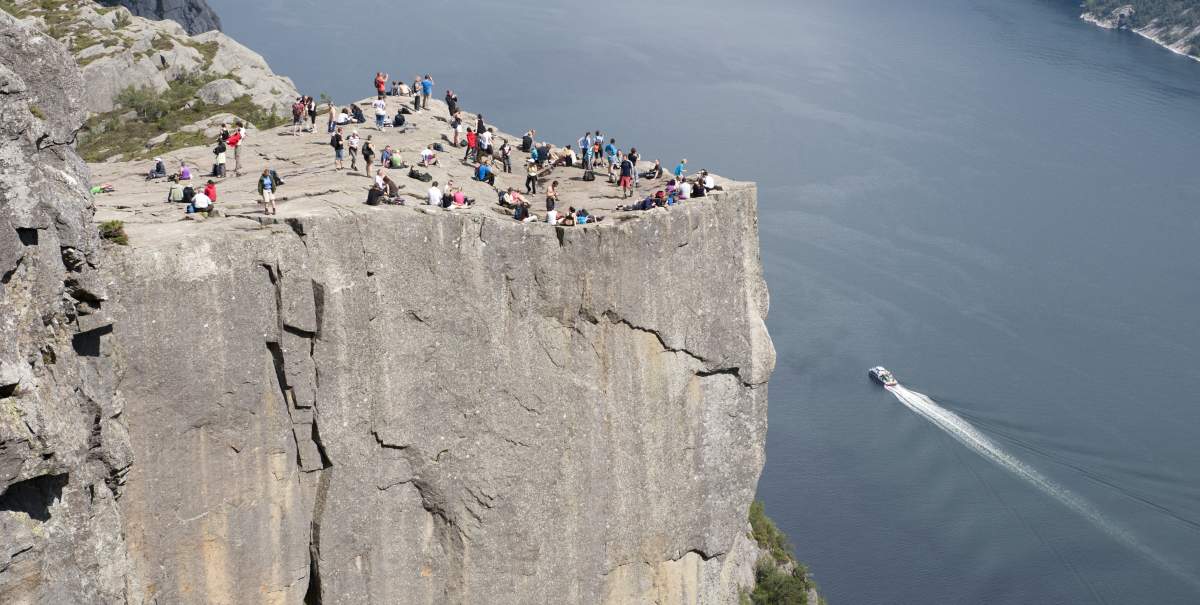
  • As lookouts go, Pulpit Rock has few peers.  Perched atop an almost perfectly sheer cliff that juts out 2000 ft above the waters of gorgeous Lysefjord,  Pulpit Rock is one of Norway’s signature images and most eye-catching destinations.  It’s the sort of place where you’ll barely be able to look as others dangle over the precipice -far more than seems advisable, even as you find yourself drawn inexorably towards the edge.  Nearly 200,000 tourists make this pilgrimage every year.  There has been only one reported incident where someone accidentally fell off while taking a jumping picture of himself. (Norway considered the idea of putting a fence around, but dropped it for the fear that people may become even less cautious.)  If you notice the big cracks across and on the sides of the rock, you know that it is bound to fall off someday - so don't wait, visit now. 
  • The official website suggests that the hike takes two hours to go up the 2 1/2 miles, 1000 ft climb, and about the same time to come back down to the Mountain Lodge (Preikestolen Fjellstue) - the starting point for the hike.  Most people take a ferry from Stavanger and then a connecting bus to the lodge, which adds another hour each way.  If you are coming from the airport, Flybuss shuttle runs every 20 minutes, and takes 30 minutes to get to the City Center.  Add it all together and you have a full-day trip, just to dangle your feet 2000 feet above Lysefjord.  Go figure!
  • Needless to say, Pulpit Rock is the main attraction of Stavanger - otherwise there is very little else to see that is unique to Stavanger.  Flybuss drops you right in front of the Ferry Terminal - the last stop.  Unless you have purchased tickets online (cheaper), or at the Ferry Terminal (closed when we got there.), you purchase them on the ferry.
  • The 40 minute ferry to Tau runs like clockwork late into the night.  Most locals bring their cars to Stavanger (and back) by the Ferry.  And then there are tourists, who don't have cars and need transportation (bus, taxi) at the other end.  Ferry plus connecting Bus designed -and priced- especially for tourists costs 250 NOK roundtrip.  The last bus leaves at 7:20 PM and drops you at the Mountain Lodge 20 km away in about 20 minutes or so.
  • We had planned to take a 3 PM flight from Bergen that would get us to Mountain Lodge by 5:40 PM, and giving us plenty of time to scope out the hike for the next day.  Well, just as we were about to leave Bergen for the airport, (thanks to Google Alert) we found out that our flight was cancelled.  The next flight was at 5 PM, which if everything goes well, would get us on the last bus to Mountain Lodge - it did.  Had we missed the last bus and had to stay in Stavanger for the night, the first ferry-bus next morning would have taken us to the Lodge earliest by 9 am - giving us only two hours for the hike.  Absolutely no way then could we have made it to Pulpit Rock.
  • On the plane, we sat next to a Britisher who lived and worked in Stavanger, and had been to Pulpit Rock - not just in Summer, but also in winter, in snow.  He told us what thrill it was, and that his girlfriend wouldn't have allowed him had she known beforehand.  He also told us that the hike is strenuous and physically demanding at places - that there were 4 climbs, third one being the longest, steepest and toughest.  A few years earlier, Nepalese Sherpa were brought in to make this trail more accessible to more people.  The four climbs were made in to steps by using boulders.  Now you don't even need hiking poles, but the climb is still steep, and rocks are rocks - uneven and at times slippery.
  • People with limited amount of time in Norway (that's just about everyone) are offered NIN (Norway in a Nutshell) program.  As explained earlier, it is NOT a guided tour, but just a collection of public transport with guaranteed connections, to see the "must see" places in Norway.  NIN to Preikestolen would have taken 4 days, including one day for the hike itself.
  • Mountain lodge was full that day mostly with Norwegian tourists who drove there, but a couple of bunk beds were available in an adjacent hostel.  There were 6 beds in our room, 6 in the next one, with a connecting kitchen and toilet facilities.  Showers were in the next building.  Linens and duvet were provided.  All this only for 320 NOK ($40) per person - the lodge rooms were going for $200.  We were happy to have reached here, and to have a place to sleep for the night.
  • The lodge has great views all around.  It was raining when we reached, and the forecast was for rain until 4 am.  Because we had to catch 11 am bus back to Tau/Stavanger next day in order to catch a 2 PM onward flight, we have to begin our hike at 6 am latest.  Hoping for the forecast to be right!
Visual Map of the Hike
  • Monday, July 13, 2015: When I woke up at 5 am, it was still drizzly but clearing up.  Rain had stopped and skies cleared by the time we left at 6 am.  There was patchy fog, but sunrise being at 4:30 am, visibility wasn't an issue.  Most of the hike was fog-free, except at Pulpit Rock itself.
    - Previous night, we were chatting with two girls in our room, who were working (exchange program) in Norway, and had finished the hike earlier that day.  They also confirmed that five hours for the hike including time at the Rock would be minimum.  So we were all set for the next morning.
    - Here are some numbers: The path starts at the Preikestolhytta at an elevation of 886 feet above sea level, and climbs to 1982 feet.  Even though the elevation differential is only 1096 feet and the walk is not particularly long (2.4 miles each way), the total elevation gain and loss over the course of the hike is more than one might initially expect, as the path climbs and descends various ridges.
    - The trail begins at the Lodge parking lot and climbs steadily right away.  First paved, then dirt trail, then gravel and finally rocks/boulders.  When you reach the first sign (shown above) you have just cleared the first climb.  You can take a breather, take pictures, and continue on a level path and boardwalk over marshy areas.  After the second climb, you start seeing signs showing distances covered vs. more to go.  Only after the third climb - which doesn't seem to end for a long time, you are at the halfway point, and you are already exhausted.  The weather was cool, but we were sweating.  It wasn't raining, but the rocks were wet so we had to be careful.  Lot of running water under and around the rocky climb.  Very peaceful and invigorating, at the same time.  By the time we were close to Pulpit Rock, sky was clear and sun was shining, but fog continued to linger over the water (Fjord) ahead of us.  Pulpit Rock is not visible until the very end.  Any time you feel that you are lost, look for red arrows pointing the way.  We were the first ones to leave the lodge a little before 6 am.  Midway through, one couple went ahead of us (and then waited for the fog to clear with us.)  Closer to the top others were camped overnight - in Norway, anyone could sleep anywhere in open field without restrictions.  They were just waking up as we passed by.
Clear skies and sunshine on the way to Pulpit Rock
  • Even when you reach the 50 meter sign, you still don't see the Rock.  Then you turn the corner, and there it is.  One arrow points to the right where you could climb further to the top of a bluff, if you like.  We noticed a few people up there later, but the view (down to the water) was still obscured by fog.  I was happy reaching the Rock before crowds got there. 
    - It was 8 am and we had almost an hour before returning.  After catching our breaths, we checked out the landscape - the 82 feet by 82 feet Pulpit and nearby rocks - to see if there is a better view from a different vantage point.  Just when the fog seemed to clear from time to time, the next wave would roll in.  We could see the reflection of the sun shining in the water, but not enough to appreciate the 2000 feet drop.  By the time we left around 9 am, there were only 10 of us - all having had breakfast/snacks (the hotel provided pre-packed sandwiches.) and waiting for the fog to clear.  At least some of them were for sure waiting to dangle their feet on the edge - when it was completely fog-free.
    - Like many, I had thought that it was foolish to sit at the edge of the cliff and dangle your feet, and in fact wondered how Norway allows it.  But I was tempted all the same.  Will I dare do it when the time actually came - I wasn't sure.  It was not windy (and hence the lingering fog), and the fog also made it seem like I was sitting on a park bench somewhere.  There was nothing to see below by lying down near the edge.  So I went and sat down sideways a couple of feet before the edge and turned myself 90 degrees to lower my feet.  Come to think of it, I should have stretched them out straight.  Reverse the steps and move away from the edge - that's it.  I suppose if it was windy it would have been different.  Any case, another item checked off the bucket list.  After taking some more pictures, we started back down.  See circular rainbows reflecting in the fog (below.)
Foggy Pulpit Rock - I am walking to it on the right.
Sun shining in the Fjord water 2000 ft below
Live dangerously!


You could go up some more if you like.


Circular rainbow(s)


Not many people when we left about an hour later,


Path to Pulpit Rock and fog rising.
  • By 9 am, the first bus of the day from Stavanger/Tau had arrived, bringing 50 or so hikers of all ages and levels of fitness who would ascend the trail (and bus every 20 minutes or so thereafter.)  The return trip was also slow because of this rush hour traffic in the opposite direction.  Climbing down was a bit easier because of gravity, though uneven and slippery rocks made you watch your step.  The trail was narrow in places where only one person could pass, but the rest was wide enough for two way traffic.  We very much appreciated leaving early for the hike, and being done before others were starting.  We returned to the Lodge around 10:45 am.  By the time we hydrated ourselves and collected our luggage, the 11 am bus had arrived and we were on our way.  Still plenty more connections where something could go wrong - bus to ferry, to airport shuttle, to flights onward (from SVG to OSL to CPG to HAM.)  It all worked out well.

Revsvatnet Lake near Pulpit Rock
Watch the PPS for this hike.