Thursday, July 16, 2015

Stockholm, Sweden

Photos
  • Thursday, July 16, 2015: Sunrise: 3:57 am, Sunset: 9:42 PM, Clear 21/13 C, 8 am - 5 PM 1 USD = 9 SEK
    - It took us one day cruising to reach Stockholm from Kiel.  Stockholm was first inhabited in the third millennium BC when several communities established settlements on the coast of what would be the future capital, after the glaciers retreated.  The city began to take shape from the 11th century onward with the arrival of Christianity.  From the 17th century, Stockholm grew exponentially, becoming a very important center for culture in the space of two centuries.  At one point, Swedish were a force to reckon with.  Even Russia had trouble defending itself from the Swedish, and therefore, Peter the Great envisioned a port city and made it a capital - St. Petersburg.
  • We took buses (Zone A 36 SEK tickets) to and from the port, and walked around the rest of the way.  Our primary attractions were Golden Hall in the City Hall (100 SEK), Nobel Museum (100 SEK), Royal Palace 0, Vasa Museum (130 SEK - free Wifi)

Ship building is what made Swedish Empire rise


All men and women have to serve for two years

Royal Palace - change of guard


Royal Palace - change of guard

Royal Palace - change of guard


Royal Palace - change of guard

Royal Palace Guard


Sunday, July 12, 2015

Pulpit Rock (Preikestolen), Stavanger, Norway


  • Sunday, July 12, 2015: Lysefjorden i et nøtteskall
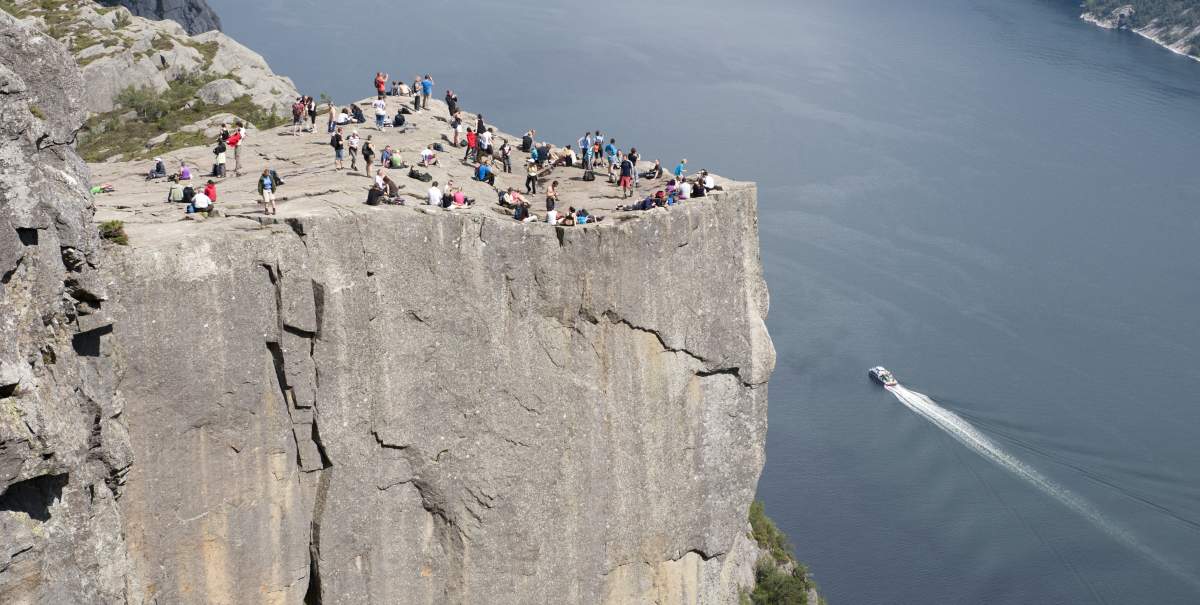
  • As lookouts go, Pulpit Rock has few peers.  Perched atop an almost perfectly sheer cliff that juts out 2000 ft above the waters of gorgeous Lysefjord,  Pulpit Rock is one of Norway’s signature images and most eye-catching destinations.  It’s the sort of place where you’ll barely be able to look as others dangle over the precipice -far more than seems advisable, even as you find yourself drawn inexorably towards the edge.  Nearly 200,000 tourists make this pilgrimage every year.  There has been only one reported incident where someone accidentally fell off while taking a jumping picture of himself. (Norway considered the idea of putting a fence around, but dropped it for the fear that people may become even less cautious.)  If you notice the big cracks across and on the sides of the rock, you know that it is bound to fall off someday - so don't wait, visit now. 
  • The official website suggests that the hike takes two hours to go up the 2 1/2 miles, 1000 ft climb, and about the same time to come back down to the Mountain Lodge (Preikestolen Fjellstue) - the starting point for the hike.  Most people take a ferry from Stavanger and then a connecting bus to the lodge, which adds another hour each way.  If you are coming from the airport, Flybuss shuttle runs every 20 minutes, and takes 30 minutes to get to the City Center.  Add it all together and you have a full-day trip, just to dangle your feet 2000 feet above Lysefjord.  Go figure!
  • Needless to say, Pulpit Rock is the main attraction of Stavanger - otherwise there is very little else to see that is unique to Stavanger.  Flybuss drops you right in front of the Ferry Terminal - the last stop.  Unless you have purchased tickets online (cheaper), or at the Ferry Terminal (closed when we got there.), you purchase them on the ferry.
  • The 40 minute ferry to Tau runs like clockwork late into the night.  Most locals bring their cars to Stavanger (and back) by the Ferry.  And then there are tourists, who don't have cars and need transportation (bus, taxi) at the other end.  Ferry plus connecting Bus designed -and priced- especially for tourists costs 250 NOK roundtrip.  The last bus leaves at 7:20 PM and drops you at the Mountain Lodge 20 km away in about 20 minutes or so.
  • We had planned to take a 3 PM flight from Bergen that would get us to Mountain Lodge by 5:40 PM, and giving us plenty of time to scope out the hike for the next day.  Well, just as we were about to leave Bergen for the airport, (thanks to Google Alert) we found out that our flight was cancelled.  The next flight was at 5 PM, which if everything goes well, would get us on the last bus to Mountain Lodge - it did.  Had we missed the last bus and had to stay in Stavanger for the night, the first ferry-bus next morning would have taken us to the Lodge earliest by 9 am - giving us only two hours for the hike.  Absolutely no way then could we have made it to Pulpit Rock.
  • On the plane, we sat next to a Britisher who lived and worked in Stavanger, and had been to Pulpit Rock - not just in Summer, but also in winter, in snow.  He told us what thrill it was, and that his girlfriend wouldn't have allowed him had she known beforehand.  He also told us that the hike is strenuous and physically demanding at places - that there were 4 climbs, third one being the longest, steepest and toughest.  A few years earlier, Nepalese Sherpa were brought in to make this trail more accessible to more people.  The four climbs were made in to steps by using boulders.  Now you don't even need hiking poles, but the climb is still steep, and rocks are rocks - uneven and at times slippery.
  • People with limited amount of time in Norway (that's just about everyone) are offered NIN (Norway in a Nutshell) program.  As explained earlier, it is NOT a guided tour, but just a collection of public transport with guaranteed connections, to see the "must see" places in Norway.  NIN to Preikestolen would have taken 4 days, including one day for the hike itself.
  • Mountain lodge was full that day mostly with Norwegian tourists who drove there, but a couple of bunk beds were available in an adjacent hostel.  There were 6 beds in our room, 6 in the next one, with a connecting kitchen and toilet facilities.  Showers were in the next building.  Linens and duvet were provided.  All this only for 320 NOK ($40) per person - the lodge rooms were going for $200.  We were happy to have reached here, and to have a place to sleep for the night.
  • The lodge has great views all around.  It was raining when we reached, and the forecast was for rain until 4 am.  Because we had to catch 11 am bus back to Tau/Stavanger next day in order to catch a 2 PM onward flight, we have to begin our hike at 6 am latest.  Hoping for the forecast to be right!
Visual Map of the Hike
  • Monday, July 13, 2015: When I woke up at 5 am, it was still drizzly but clearing up.  Rain had stopped and skies cleared by the time we left at 6 am.  There was patchy fog, but sunrise being at 4:30 am, visibility wasn't an issue.  Most of the hike was fog-free, except at Pulpit Rock itself.
    - Previous night, we were chatting with two girls in our room, who were working (exchange program) in Norway, and had finished the hike earlier that day.  They also confirmed that five hours for the hike including time at the Rock would be minimum.  So we were all set for the next morning.
    - Here are some numbers: The path starts at the Preikestolhytta at an elevation of 886 feet above sea level, and climbs to 1982 feet.  Even though the elevation differential is only 1096 feet and the walk is not particularly long (2.4 miles each way), the total elevation gain and loss over the course of the hike is more than one might initially expect, as the path climbs and descends various ridges.
    - The trail begins at the Lodge parking lot and climbs steadily right away.  First paved, then dirt trail, then gravel and finally rocks/boulders.  When you reach the first sign (shown above) you have just cleared the first climb.  You can take a breather, take pictures, and continue on a level path and boardwalk over marshy areas.  After the second climb, you start seeing signs showing distances covered vs. more to go.  Only after the third climb - which doesn't seem to end for a long time, you are at the halfway point, and you are already exhausted.  The weather was cool, but we were sweating.  It wasn't raining, but the rocks were wet so we had to be careful.  Lot of running water under and around the rocky climb.  Very peaceful and invigorating, at the same time.  By the time we were close to Pulpit Rock, sky was clear and sun was shining, but fog continued to linger over the water (Fjord) ahead of us.  Pulpit Rock is not visible until the very end.  Any time you feel that you are lost, look for red arrows pointing the way.  We were the first ones to leave the lodge a little before 6 am.  Midway through, one couple went ahead of us (and then waited for the fog to clear with us.)  Closer to the top others were camped overnight - in Norway, anyone could sleep anywhere in open field without restrictions.  They were just waking up as we passed by.
Clear skies and sunshine on the way to Pulpit Rock
  • Even when you reach the 50 meter sign, you still don't see the Rock.  Then you turn the corner, and there it is.  One arrow points to the right where you could climb further to the top of a bluff, if you like.  We noticed a few people up there later, but the view (down to the water) was still obscured by fog.  I was happy reaching the Rock before crowds got there. 
    - It was 8 am and we had almost an hour before returning.  After catching our breaths, we checked out the landscape - the 82 feet by 82 feet Pulpit and nearby rocks - to see if there is a better view from a different vantage point.  Just when the fog seemed to clear from time to time, the next wave would roll in.  We could see the reflection of the sun shining in the water, but not enough to appreciate the 2000 feet drop.  By the time we left around 9 am, there were only 10 of us - all having had breakfast/snacks (the hotel provided pre-packed sandwiches.) and waiting for the fog to clear.  At least some of them were for sure waiting to dangle their feet on the edge - when it was completely fog-free.
    - Like many, I had thought that it was foolish to sit at the edge of the cliff and dangle your feet, and in fact wondered how Norway allows it.  But I was tempted all the same.  Will I dare do it when the time actually came - I wasn't sure.  It was not windy (and hence the lingering fog), and the fog also made it seem like I was sitting on a park bench somewhere.  There was nothing to see below by lying down near the edge.  So I went and sat down sideways a couple of feet before the edge and turned myself 90 degrees to lower my feet.  Come to think of it, I should have stretched them out straight.  Reverse the steps and move away from the edge - that's it.  I suppose if it was windy it would have been different.  Any case, another item checked off the bucket list.  After taking some more pictures, we started back down.  See circular rainbows reflecting in the fog (below.)
Foggy Pulpit Rock - I am walking to it on the right.
Sun shining in the Fjord water 2000 ft below
Live dangerously!


You could go up some more if you like.


Circular rainbow(s)


Not many people when we left about an hour later,


Path to Pulpit Rock and fog rising.
  • By 9 am, the first bus of the day from Stavanger/Tau had arrived, bringing 50 or so hikers of all ages and levels of fitness who would ascend the trail (and bus every 20 minutes or so thereafter.)  The return trip was also slow because of this rush hour traffic in the opposite direction.  Climbing down was a bit easier because of gravity, though uneven and slippery rocks made you watch your step.  The trail was narrow in places where only one person could pass, but the rest was wide enough for two way traffic.  We very much appreciated leaving early for the hike, and being done before others were starting.  We returned to the Lodge around 10:45 am.  By the time we hydrated ourselves and collected our luggage, the 11 am bus had arrived and we were on our way.  Still plenty more connections where something could go wrong - bus to ferry, to airport shuttle, to flights onward (from SVG to OSL to CPG to HAM.)  It all worked out well.

Revsvatnet Lake near Pulpit Rock
Watch the PPS for this hike.

Friday, July 10, 2015

Bergen, Norway

  • Thursday, July 9, 2015:  Having checked off the first item ("midnight sun") from our bucket list on the very first day in Norway, we were off to Bergen for the next three days with no firm plans.  We left Tromso (TOS) at 2:25 PM on a Wideroe - commuter airline of SAS - prop plane for a 2 1/2 hour ride along Norway's Atlantic coastline 1000+ miles south to Bergen, enjoying wonderful views of fjords, islands, snow-capped mountains and surrounding greenery through partly cloudy skies.  We reached Bergen (BGO) airport at 4:50 PM, and city center -12 miles away- about an hour later.  - Flybuss Airport Shuttle is the most convenient transport during summer months in Norway's most major cities (only during summer tourist season, like most other activities.)  Buses run every 15-20 minutes apart and take 45-50 minutes to reach the other end.  For more than one person, taxi may be comparable or cheaper.  Sometimes, local buses are also available and can be even cheaper though slower.
    - In general, it is cheaper to purchase tickets at the vending kiosk (or online) than on the bus - though sometimes the difference is minimal like 10 NOK.  Some bus drivers can't accept credit cards, so you need cash.  Round trip tickets are cheaper than two single tickets.  In Bergen, 90 NOK one way vs 160 NOK round trip.  Just show the receipt when you board the bus.
    Our stop was Fish Market, right in the heart of city center and near all tourist attractions - not to mention shops and restaurants.  When facing the harbor and fish market, you see Bryggen and Fort just beyond to the right.  To the left was the "pedestrian only" plaza - as is common in many European cities.  Much to their surprise, local merchants find that MORE, not LESS, customers visit their stores when there are no cars around. Our accommodations were only a couple of blocks away.  But first, we visited the Tourist Information center (a big white "I" in a green square.) above the fish market.  This Tourist Information center is open long hours, and not only gives maps and information, they also book tickets for you on the spot.  Because it rains 300 days a year in Bergen, it was important to plan activities around the weather.  Tomorrow (Friday) was going to be clear, so we better go visit a fjord.Large TV and other displays and brochures tell you all about nearby attractions while you wait for your number to be called. The wait could be long even though they have plenty of counters
    - one counter is primarily for money exchange (you can get a better exchange rate at an ATM), and one for tours, but all of them can answer your questions. (As you enter, there is an electronic machine to take a number.  TIP: Pick the one that has the least wait for faster service.)
    - I had looked at NIN (Norway in a Nutshell) earlier - it offers a variety of plans of different starting points and different lengths.  I knew that at most, we could do a one day plan.  On TripAdvisor and RickSteves, I had read about people trying to do NIN on their own and save some money, but wasn't quite sure how it worked.  NIN is NOT a guided tour, though occasionally some announcements are made about points of interest.  Otherwise, it is just a prepaid collection of connecting public transportation modes - you won't miss a connection if you followed the crowds.  Meals are on your own.- For one day plan, we could do "Sognefjord in a nutshell" - a five hour travel through much of the Sognefjord to Flam, and return via Flam train to Myrdal and back to Bergen.  This would however miss the famous Naeroyfjord arm. 
    Alternatively, we could do the standard NIN, the most popular route where we first take train from Bergen to Voss (1 hour), then bus to Gudvangen at Naeroyfjord (1 hour), followed by a 2 hour Fjord cruise through the Naeroyfjord arm to Sognefjord to Flåm, then Flåm Railway to Myrdal (1 hour,) and another train back to Bergen via Voss (2 hours.)  Or, the whole trip could be reversed.  Ticket for this 12 hour, 250 mile adventure by bus, boat and trains is 1220 NOK ($150.)
    - Sognefjord is the longest fjord in Norway (127 miles), and the longest ice-free one in the world.  One of its arms, Naeroyfjord, has been listed as a UNESCO World Heritage Site.  It is a dramatic, narrow fjord 11 miles long, only 800 feet wide and 35 feet deep in some parts, with steep mountain sides and tiny farms clinging to them.  And of course, plenty of waterfalls in summer months.  At the deepest point, Sognefjord is over 4000 feet deep, with mountains rising 4000 feet on the sides.  Very dramatic views all around. 
    We needed some time to think so we decided to check in to our apartment first and come back. We returned to the Information Center only to find out that NIN may be sold out for the next day - how could that happen on public transport?  Any case, we got the tickets we wanted, in the direction we preferred, and with additional two hours in Flam to walk around.  This was late at night when you couldn't purchase it online, and other tourist offices were closed.  We were the last ones to get tickets for that day.  We got lucky with the weather too - the next day turned out to be a great sunny day.
    AirBnBThis was my first experience with AirBnB - that too internationally, and for 3 days in one shot.  The one bedroom apartment was very conveniently located - walking distance to everywhere we wanted to go.  Finding it wasn't difficult either, but the owner did not live in Bergen.  She had asked one of her friends to bring us the keys - we didn't know that.  As Plan B, the owner had asked us to pick up keys from the hair dresser shop downstairs if they were open - so we did.  Once inside the apartment, we had WiFi / internet connection and we were able to connect with the owner - and find out what's where.  Little things that we know exactly where they are and how they work in our own homes, are not so obvious to others - especially in another country.  How does the shower turn off completely, where are the bed sheets, how does the washer/dryer work, where is the microwave, where is the switch for the heater (even in summer?), how does the TV work? - it felt silly asking those questions. 
Other than fjords and scenery (and beautiful blondes - men and women of course), Norway is known for being notoriously expensive - and that is an understatement at times.  This could be said about all Scandinavian countries in general, but Norway seems to be on top.  You know this when you see McDonald's advertising their standard breakfast special for 110 NOK, and a hoagie sandwich at 7-11 costs 50 NOK.  Restaurant lunches could be 150-200 NOK and dinner 300+.  A single bus ride is 50 NOK.

Although Norway boasts high per capita income for its 5 million citizens, how do they manage?  By NOT eating out, I was told.  One ex-pat US citizen now settled in Oslo explained that on most days, we eat at home - meat and potatoes.  And on special occasions we go out for a Pizza or McDonald's.

Any case, we had seen Coop supermarkets in Tromso.  In Bergen, Rema 1000 are everywhere - one was next to the Information Center.  We needed something for dinner that night, and for all day next day.  Then one day we were going to splurge.  A 40 NOK frozen pizza (our apartment had oven), 10 NOK Danish/Donuts, a bag of 4 Ciabatta rolls for 10 NOK, half a pound of Swiss Cheese and Ham for 30 NOK each, and 1.5 liter juice for 20 NOK - felt like such an inexpensive deal compared to the prices noted above.
  • Friday, July 10, 2015:  Friday was NIN all day.
  • Saturday, July 11, 2015:  Bergenthe self-proclaimed “Gateway to the Fjords,” is the second largest city in Norway after Oslo, and is itself on Bergenfjord.  For sightseeing, you'd want to head south to Hardangerfjord, or north to the Flåmsdal valley, where the inspiring Flåmsbana mountain railway trundles down to the Aurlandsfjord, a small arm of the mighty Sognefjord. - Slightly further North than Oslo, Bergen (60.3894° N, 5.3300° E) is an ancient Viking port steeped in medieval history.  The most fascinating sites here are the 12th-century Fantoft Stave Church with its rooftop dragons; Haakon's Hall, where the Norwegian kings were crowned; and Troldhaugen, the lakeside home of composer Edvard Grieg.  Then there were so many other things you could do/see just by walking around this easily walkable city. 
    - Today, we decided to start early, again, because the forecast was for rain in the afternoon.  During my morning walk, I had explored the surrounding area - like lake, car-free shopping area, wooden houses, and so on to visit later in the day.  We began with a hike to the top of Mount Floyen, just one block away from our apartment.  There are numerous ways to get there, including driving up on a paved road or a funicular.  Homes dot the entire slope of the mountain, and are connected with smaller roads as well as stairs in every direction.  As long as you keep climbing up, you will eventually get to the top.  Going on a trail is the best once you get to it.  The hike is long, though not difficult.  It is popular with locals walking their dogs, as well as with tourists.  Those who are short on time or don't like to climb can take Funicular - one way or both ways.  A large viewing platform adjacent to the Funicular station at the top gives you a nice view to the South and West, all the way to the ocean several miles away.

Photo
Bergen City center, Wharf and beyond.

  • Coming down a different way, passing by a small lake with picnic areas all around, we ended up at the lower station of the Funicular.  Tour buses were just arriving, and tourists were marching towards the Funicular.  Soon, we were back at the the pier.  Around the corner was the famous Bryggen Hanseatic Wharf, with wooden houses behind, churches, a fort and a museum beyond.  On the other side of the museum is where the cruise ships anchor - very convenient way to sightsee Bergen.  (We saw Costa Pacifica docked there.  We will get on it in Kiel 3 days later.)


Bryggen - wooden houses behind 
Fort

Church inside the fort

Another Church


Logos of past empires that ruled Bergen

  • At the Information Center, we were told that the only place in Bergen that serves whale steaks is Bryggeloftet & Stuene, near Bryggen - on our way back to the apartment.  It was just before noon - not quite lunch time, so restaurants were nearly empty.  Norway is known for NOT being Vegetarian friendly.  Common diet is meat and fish (and potatoes.)  Reindeer fillet and Whale steak would be worth trying once, no matter what the price.  So we went in.  Had a window facing the wharf, watching people go by.  Although normally served as dinner, it was available anytime - so we ordered.  Whale was described as a "different" taste, whereas Reindeer as "wild."  The description fit fairly well.  Another box checked of our list.  Price tag - Only 700 NOK. 
  • It looked like rain so we returned to our room for a while.  Later in the evening, we walked around the lake, the university, the car-free shopping district on the South side of the harbor.
  • Tomorrow will be travel day - to Stavanger.


Mount Floyen


Thursday, July 9, 2015

One day NIN (Norway in a Nutshell) from Bergen

Voss/ Flam/ Myrdal Photos
  • Friday, July 10, 2015: We were asked to reach Bergen Central Railway station to catch 8:43 am train next morning.  The itinerary was as follows: Train from Bergen 08:43 To Voss 09:56, Bus from Voss 10:10 To Gudvangen 11:05, Boat from Gudvangen 11:45 To Flåm 14:10.  We had time at Flam to walk around and see the Flåm Railway Museum.  Train from Flåm 16:05 To Myrdal 17:03, Train from Myrdal 17:13 To Bergen 19:57.  A booklet with tickets for each part - like good old airline tickets of the past - was our guide.
  • We reached the train station 20 minutes early - only a 10 minute walk from our apartment.  A large NIN board pointed left to our train.  First three cars were reserved solely for NIN passengers going to Voss, the rest of the train was continuing on to Myrdal and beyond - announcements were constantly made, yet some people ended up in wrong cars anyways.  Five minutes before departure, they made yet another announcement in Norwegian.  Everyone who understood it got up and started getting off our car.  Because of some malfunction, everyone from our car had to move to another car.  We still got the window seat on the left side (for better views.)
  • The train left on time and reached Voss around 10 am.  Views of the fjord and bridges crossing over it were indeed wonderful, though the train spent most of the time in tunnels.  Unless you kept your camera ready at all times, the view was already behind you.  No pictures.
  • At Voss, our three cars were told to disembark, exit the platform, go right and board buses waiting for us.  Though the buses looked all the same, it appeared that people were grouped by language and tour groups.  Most on our bus spoke English, but the driver had trouble with it.  Any case, the whole caravan left as soon as everyone boarded, and we were off to Gudvangen.  Large picture windows made it easy to see on all sides and take pictures.  The trip began in a wide open valley with mountains and waterfalls on either side of the road, then narrow winding single lane roads down the hills, around the mountains and lakes, finally to the Ferry Dock at Naeroyfjord.  


  • Buses then wait for the arriving Ferry to take passengers back to Voss.  Ferries are also commuter service to Flam and back, and stop at intermediate stops as necessary.   This slow moving ferry gives you plenty of time (two hours) to enjoy the Fjord.

Naeroyfjord 

Naeroyfjord 

Naeroyfjord 

  • Ferry carried some locals, but mostly tourists.  Some were on organized tours, rest on NIN like us.  The ferry was full - crowded on all decks.
    - Some were happy stopping at the first level to enjoy meals and drinks.  Others were on the open deck, and many others like me on the top deck.  There were plastic chairs, or you could stand against the railings.  Views on either side were
    mesmerizing and peaceful.  Occasionally, you heard Oooh's and Aaaah's coming from the other side (or an announcement), and then you moved around to see what they were admiring.  After the initial mad rush to find the "best spot," people settled down.  There was a flat raised platform in front of me.  There was constantly someone - sometimes several - standing on it for a better view and to take pictures.  The view from the very front (as you see in the pictures) was of course the best.
  • We started from the end of Naeroyfjord arm going towards the main Sognefjord.  Soon, we reached the narrowest point - only 800 feet wide and 35 feet deep - with steep mountains on both sides.  That was the power of glaciers cutting such deep gashes through hard rocks.  Normally, cuts are the deepest (4000 feet in Sognefjord) farthest away from the ocean and fjords become shallow closer to where they meet Atlantic Ocean, because of sediments.  The water is ocean (salt) water, brackish where fresh water from waterfalls mixes it up a bit.  There are some remnant glaciers here and there, but because of moderate climate, most snow is fresh snow.  As for the beauty of this natural wonder, pictures speak for themselves.
  • Along the way, we encountered many speedboats coming from Flam - bringing tourists from cruise ships for a quick view of Naeroyfjord - a great solution if you are short on time.  I wouldn't have been satisfied.
  • After the 2 1/2 hour boat ride, people were anxious to get off the ferry (and rush to the restrooms.)  The adjacent visitor center offered many options of "Things to do in Flam" depending on how much time you had.  The railway station is literally a stones throw from where the ships (ferry as well as cruise ships) dock.  Boutique shops surround the place.  Some people stayed overnight at nearby hotels; most were catching the next train to Myrdal departing shortly.  A few like us had a couple of hours to spare in Flam.  We visited the nearby Flåm Railway Museum that showed the history of how this railway was built, life in Flam in those days, difficulty in building one of the steepest railroad tracks, and plenty of specimens.  Good for a quick overview.
  • We walked through the town, up to the water - touching and tasting to make sure that it was in fact salt water, around the fjord up to the highway,  Highway E16, hugs the fjord near Flam, passes through tunnels and takes you back to Voss - part of the grand Europe Unification plan of infrastructure building.  We returned in time to catch our 4:05 PM train.  This time, we were told to sit on the right side for better views of waterfalls. 
  • Any train ride is wonderful in its own right.  If you get a chance to ride the Flam train - which goes up the mountain to Myrdal - don't miss it.  From the village of Flåm, it climbs 2,835 ft up in only 12 miles—the steepest unassisted railway climb in the world.  Two trains run in the opposite directions - because part of the way is single track, they wait for each other at a midway station.  Although our train left on time, we had to wait for the downhill train to come by.  Right side of the train has lots of waterfalls, valley, river and towns - most of the way. 

River runs through it!

More waterfalls

Shiny River

Waterfall


  • Although we were running late, I was surprised when they announced a 5 minute stop in the middle of nowhere.  The real surprise was the “Mystical Lady of the Mist!”  An enormous 305 foot Kårdalsfossen waterfall rushing down, with a wooden platform built so close that you get wet in the mist. During this 5 minute stop, be sure to hop off the train to admire it, take pictures, get wet watching a rainbow AND watch the dance of the Mystical Lady.  This lady in red is dancing to loud music, then disappears and reappears in various places to the right of the waterfall.  A surprise treat for young children and adults alike.

Kårdalsfossen Waterfall

Rainbow

Watch the enormous waterfall.  Don't miss the mystical lady in red dancing to the music.

  • After 5 minutes, everyone is herded back on the train, and we marched on to Myrdal on the steepest curves - mostly through tunnels.  Flam train stops on one side of the platform, and conveniently, on the other side is your train to Bergen.  That train was also running 10 minutes late.
  • Soon, the train arrived and after confirming that it was in fact a Bergen bound train, we got on.  It was, but not the one on which we had confirmed seats, as we found out later.  As a general rule, you occupy any open seat on the train.  Myrdal is high up near the tops of mountains, with lakes and snow capped mountains surrounding on all sides.  Another place to stay overnight and hike around.  Soon after leaving Myrdal, the train passes through a long tunnel, and then opens up to views of mountains, lakes and rivers all the way to Voss.  
  • At Voss, many people got on the train and claimed their assigned seats.  We had to give up ours, but where were our seats?  When we asked the conductor, we realized that our reserved seats were on the train behind us.  This was an earlier train.  Any case, they found us seats in the family car -- designed for families with kids, and has play areas like those in McDonald's.  We were tired by now and needed to take a nap - this was a good place and not too noisy either.  We had seen the rest of the way to Bergen this morning - hugging the coastline of the fjords, mostly through tunnels.
  • We were back in Bergen by 8 PM as originally planned.  There was still plenty of light outside.  We returned to our apartment having had a great experience - thanks also to great weather.
If there’s one familiar and enticing image of Norway - it’s the fjords, giant clefts in the landscape running from the coast deep into the interior.  Rugged yet serene, these huge, wedge-shaped inlets are visually stunning.
- The fjords are undeniably beautiful, especially around early May, after the brief Norwegian spring has brought color to the landscape; but winter, when all is unerringly quiet, has its charms too, the blue-black waters of the fjords contrasting with the blinding white of the snow that blankets the hills, valleys and mountains.  In summer, the wilds are filled with hikers and the waters patrolled by a steady flotilla of bright-white ferries, but don’t let that put you off: the tourists are rarely in such numbers as to be intrusive, and even in the most popular districts, a brief walk off the beaten track will bring solitude in abundance.
- The fjords run all the way up the coast from Stavanger to the Russian border, but are most easily – and impressively – seen on the west coast near Bergen.  Dotted with pretty village resorts, the Sognefjord is the longest and deepest of the country’s fjords.